
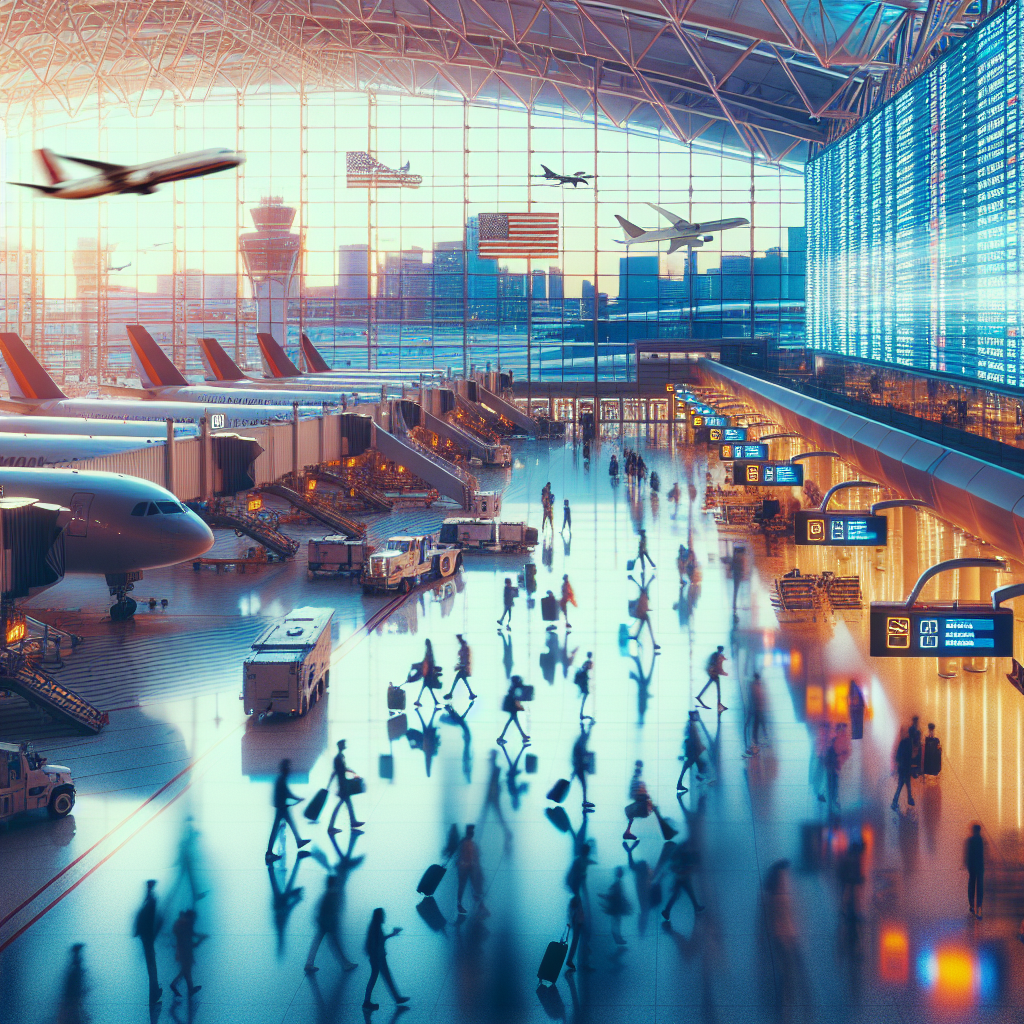
2025’s Busiest US Airports: No. 3 Will Shock You!

Air Travel Trends: Top 10 Busiest Airports in the US for March 2025
As air travel in the United States continues to flourish, March 2025 marks a significant milestone with 655 airports providing scheduled services across the nation. The top 10 busiest airports remain consistent, collectively accounting for 35% of the country’s total air travel capacity. In this article, we will explore the busiest US airports and the trends shaping air travel today.
Overview of the Busiest Airports in the US
In recent months, airports like Orlando International Airport and Phoenix Sky Harbor International Airport have experienced a remarkable 7% year-over-year increase in passenger capacity, signaling robust demand in these regions. Let’s take a closer look at the busiest airports in the United States for March 2025.
1. Atlanta Hartsfield-Jackson International Airport (ATL)
Atlanta Hartsfield-Jackson International Airport retains its title as the busiest airport in the United States, boasting an impressive 5,369,683 scheduled seats. As a primary hub for Delta Air Lines, ATL’s strategic location makes it a crucial gateway for both domestic and international flights.
- Key Features:
- Over 1,000 daily flights.
- Strong connectivity in both domestic and transatlantic markets.
- Ongoing infrastructure investments to enhance passenger experience and manage future growth.
2. Dallas/Fort Worth International Airport (DFW)
In second place, Dallas/Fort Worth International Airport reports 4,418,156 seats. As the largest hub for American Airlines, DFW is essential for facilitating passenger transfers across the country and internationally.
- Highlights:
- Central location serving as a vital transfer hub for domestic flights.
- Expanding international routes to Europe, Asia, and Latin America.
- Infrastructure upgrades to accommodate rising passenger numbers.
3. Denver International Airport (DEN)
Denver International Airport ranks third with 4,120,146 scheduled seats. This airport serves as a major hub for United Airlines and Southwest Airlines, reflecting strong demand for both leisure and business travel.
- Why It Matters:
- Strategic location connecting the East and West coasts efficiently.
- High-altitude setting enhances long-haul flight operations.
- Key player in the US aviation network.
4. Chicago O’Hare International Airport (ORD)
Chicago O’Hare International Airport remains a top contender, offering 3,991,850 seats this month. As a hub for both United Airlines and American Airlines, ORD is pivotal for domestic and international connections.
- Notable Aspects:
- Extensive flight network connecting passengers globally.
- Essential for transatlantic and transpacific routes.
- Maintains efficiency despite occasional weather disruptions.
5. Los Angeles International Airport (LAX)
With 3,754,459 scheduled seats, Los Angeles International Airport is the busiest airport on the US West Coast. As a hub for American Airlines, Delta Air Lines, and United Airlines, LAX plays a crucial role in transpacific travel.
- Key Developments:
- Nonstop flights to Asia, Europe, and Latin America.
- Upcoming automated people mover system to ease congestion.
6. Orlando International Airport (MCO)
Orlando International Airport has seen a 7% year-over-year increase, reaching 3,261,996 seats. Known for its leisure travel demand, MCO is a favorite for families visiting Disney World and Universal Studios.
- Growth Factors:
- Strong domestic traffic.
- Expanding international connections.
7. Miami International Airport (MIA)
Miami International Airport ranks seventh with 3,094,535 scheduled seats. It serves as the primary gateway between the US and Latin America, benefiting from robust international travel demand.
- Significance:
- Expanding networks by American Airlines and LATAM.
- Strong cargo operations enhancing overall importance.
8. Phoenix Sky Harbor International Airport (PHX)
Phoenix Sky Harbor International Airport has also achieved a 7% increase in capacity, with 3,112,982 seats. As a hub for American Airlines and Southwest Airlines, PHX is vital for domestic routes.
- Highlights:
- Major connections to the West Coast and beyond.
- Recent expansions driving continued growth.
9. Las Vegas Harry Reid International Airport (LAS)
Las Vegas’ Harry Reid International Airport expects to handle 3,058,792 passengers this month, fueled by interest from tourists and business travelers alike.
- Key Points:
- Diverse airline services catering to leisure and business travel.
- Increasing international routes, particularly to Mexico and Canada.
10. John F. Kennedy International Airport (JFK)
Rounding out the list, New York’s John F. Kennedy International Airport offers 3,080,095 scheduled seats. As a major hub for transcontinental flights, JFK is essential for global connectivity.
- Importance:
- Extensive networks operated by Delta, American, and JetBlue.
- Critical gateway for transcontinental and international flights.
Conclusion
The top 10 busiest airports in the US play a vital role in the nation’s aviation landscape, collectively managing a significant portion of total scheduled capacity. As travel demand evolves and airlines adapt their strategies, these rankings will likely shift in the coming months.
For more insights into air travel trends and airport developments, feel free to share your thoughts in the comments or explore related articles on our site.
Learn more about air travel trends here and check out airport infrastructure updates for deeper insights.