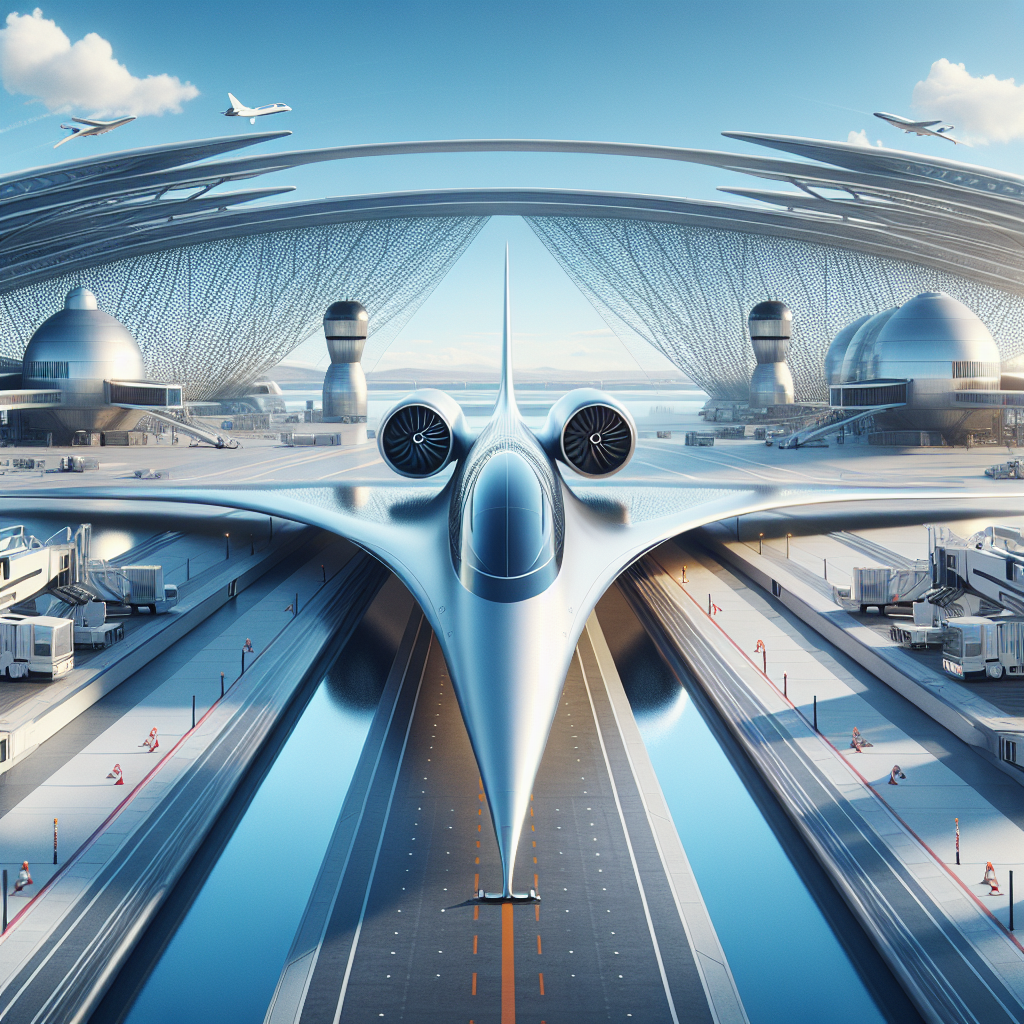
China Launches COMAC C949: A Supersonic Concorde Rival

China Unveils Ambitious C949 Supersonic Airliner: A Leap Towards High-Speed Air Travel
BEIJING – The Chinese state-owned aerospace giant COMAC has unveiled plans for the C949, a groundbreaking supersonic airliner set to redefine the future of air travel. Promising to exceed the capabilities of the retired Concorde, the C949 aims for a longer range and noise reduction, positioning China as a formidable player in high-speed aviation technology.
With a remarkable range of 11,000 kilometers—50% longer than the Concorde’s 7,200 kilometers—the C949 will also produce only one-twentieth of the iconic sonic boom, generating noise levels comparable to that of a hairdryer at just 83.9 Perceived Level in decibels (PLdB). This innovation could pave the way for regulations that have historically prohibited supersonic flights over land.
Advanced Features of the C949
Led by the renowned aerodynamicist Wu Dawei, COMAC engineers detailed the C949’s innovative features in the journal Acta Aeronautica Sinica on March 14. The aircraft aims to achieve two key improvements over the Concorde:
- Noise Reduction: The C949’s design seeks to mitigate regulations against supersonic flights over land.
- Extended Range: With a substantial range increase, the aircraft will facilitate quicker long-distance travel.
Innovative Design Elements
The C949’s design incorporates several cutting-edge features:
- A shape-shifting fuselage with a curved "reverse-camber" midsection helps weaken shock waves, minimizing sonic booms.
- A long, needle-like nose designed to split the leading shock wave into gentler pulses.
- Aerodynamic bulges near the engines that scatter exhaust turbulence, further reducing trailing noise.
- An artificial intelligence-powered control system that manages complex aerodynamics at high speeds.
Engineering Marvels
This supersonic jet boasts a dynamic fuel system capable of shifting 42,000 kilograms of fuel across seven tanks to maintain balance during flight. The C949 will be powered by twin adaptive-cycle turbofan engines, enabling cruising speeds of Mach 1.6 in "low-boom" mode or Mach 1.7 in "eco" mode at an altitude of 16,000 meters. As COMAC claims, the take-off noise adheres to international standards, making it suitable for urban airport operations.
Market Potential for Supersonic Travel
The C949 is designed to accommodate 28 to 48 passengers in a business-class configuration. With its extended range, the aircraft could complete a flight from Shanghai (PVG) to Los Angeles (LAX) in approximately five hours. Wu’s team estimates that the potential market for supersonic passengers could reach 45 million annually, representing about 1% of global air traffic. Initially, the C949 would operate trans-Pacific routes to mitigate noise concerns.
Project Timeline and Challenges Ahead
COMAC aims for the C949 to enter service by 2049, coinciding with the centenary of the People’s Republic of China. This timeline aligns with the planned launches of other COMAC aircraft, such as the C929 twin-aisle airliner slated for 2027 and the 400-seat C939 expected by 2039.
However, significant challenges remain. The C949 must achieve fuel efficiency levels that surpass those of the Concorde to ensure economic viability. Additionally, lingering public concerns about the safety of supersonic travel, especially in the wake of the Concorde’s 2000 crash in Paris, must be addressed.
The C949 symbolizes China’s strategic entry into the competitive arena of supersonic passenger travel, joining initiatives like NASA’s X-59 program and private ventures such as Boom Supersonic.
What are your thoughts on the future of supersonic travel? Share your opinions in the comments below or explore related articles to learn more about this exciting advancement in aviation technology!