Emergency Landing at JFK: American Airlines E175 Flight Details

Emergency Landing of American Airlines Flight
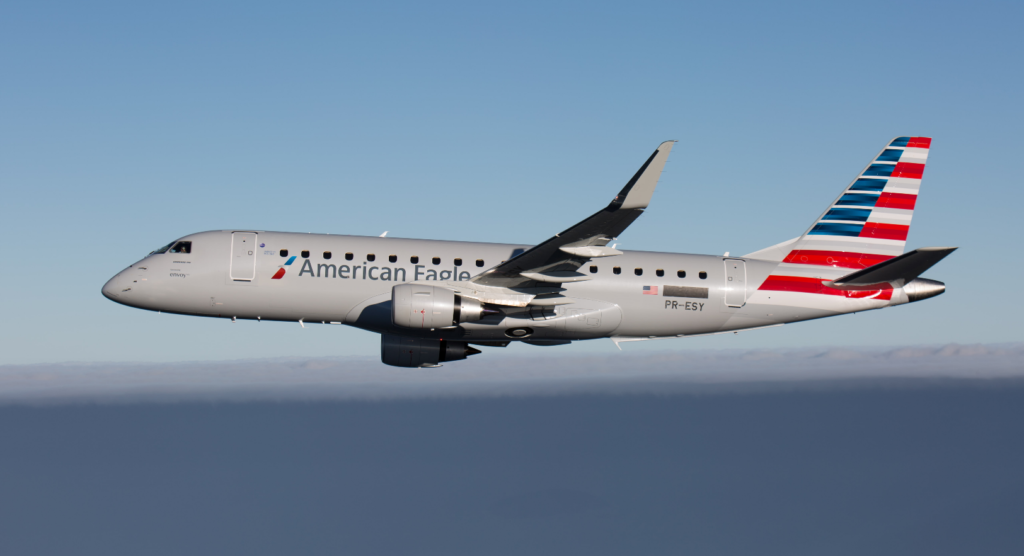
NEW YORK- A regional carrier of American Airlines, Republic Airways (YX), experienced a critical situation on flight RPA4379 operating an Embraer E175LR. The flight, en route from New York LaGuardia Airport (LGA) to Nashville International Airport (BNA), declared a MAYDAY shortly after takeoff due to an engine failure.
The flight crew reported an issue with engine number two and asked for an immediate diversion to New York John F. Kennedy Airport (JFK). Fortunately, the aircraft landed safely after executing an overweight approach while emergency services were on standby.
Flight RPA4379’s Emergency Landing at JFK
When flight RPA4379, registered as N409YX, took off from LaGuardia (LGA) heading to Nashville (BNA), the crew suddenly heard a loud noise. Shortly after, they declared an emergency due to the malfunction of engine number two.
Air Traffic Control (ATC) quickly cleared the aircraft for a diversion to JFK. The controllers provided precise radar vectors, altitudes, and holding options, allowing the crew to focus on their checklists.
During the exchanges, the pilots confirmed there were 68 individuals onboard with approximately 13,000 pounds of fuel—sufficient for a three-hour flight.
As the aircraft approached JFK, the crew informed ATC about their plan for an overweight landing due to the fuel weight. Emergency services were positioned near runway 22L prior to the aircraft’s arrival.
Effective Coordination between ATC and Pilots
The communication between ATC and the flight crew was characterized by calm and efficient exchanges during this emergency. Key points from their discussions included:
- The crew’s MAYDAY declaration and request for vectors to JFK.
- Confirmation of passengers and fuel levels on board.
- Requests for additional time to complete pre-landing checklists.
- A decision to conduct a 15-mile final approach to maintain stability.
- Notification of the planned overweight landing.
Upon landing, the crew requested an inspection of the aircraft, following the previously mentioned loud noise and fuel-heavy landing. The aircraft held on a taxiway for about 40 minutes while inspections took place.
Positive Resolution of the Situation
Thankfully, the overweight landing was conducted safely, and there were no injuries reported among passengers or crew. Emergency responders performed standard inspections of the engine and airframe before allowing the aircraft to proceed.
Republic Airways operates regional flights for major airlines across the United States and has yet to release a public statement regarding this incident.
Understanding Overweight Landings
Commercial jets have maximum weight limits for both takeoff and landing. If a diversion occurs shortly after takeoff, an aircraft may retain substantial fuel, which can exceed its landing weight limit. To manage this, pilots must either burn off or dump fuel, whenever possible, or prepare for an overweight landing.
In this instance, the Embraer E175 lacks a fuel dumping system, which forced the crew to approach with an overweight landing. Such maneuvers typically require inspections to assess for any structural or braking stress.
Communication Between ATC and Pilots
The following is a detailed transcript of the conversations between JFK ATC and the Republic Airways pilots during the emergency:
{ts:21}
ATC: 4379, radar contact, maintain 15,000.
ATC (seconds later): 5,000—Brickyard 4379, turn left heading 340, standby.
Pilot: Brickyard 4379, we’ve got an engine issue.
{ts:39}
ATC: Roger, departure. Brickyard 4379.
Pilot: MAYDAY. We’d like vectors to JFK. Engine 2 failure.
{ts:49}
ATC: Brickyard 4379, roger. Maintain 3,000 if you can and you’re cleared to Kennedy—radar vectors.
{ts:59}
Pilot: 3,000, radar vectors for Kennedy, Brickyard 4379.
ATC: Brickyard 4379, when you can: souls on board and fuel?
{ts:68}
ATC: Turn right heading 150, Brickyard 4379.
Pilot: Right 150, Brickyard 4379.
{ts:80}
ATC: Brickyard 4379, I’m bringing you into Kennedy. Let me know if you need extra time.
Right now they’re landing runway 13 left.
Pilot: Yeah, can we get some delay vectors, please?
{ts:96}
ATC: Roger, fly heading 150.
{ts:102}
Pilot: 150 on the heading, Brickyard 4379.
ATC: Brickyard 4379, contact Kennedy approach on 125.7. And if you can relay the information: souls on board and fuel—need that frequency again.
Pilot: 125.7 for Brickyard 4379.
{ts:127}
Pilot: Checking in, number two failure. Standby for souls on board, heading 3,000.
{ts:136}
ATC: Brickyard 4379, let me know if you want some time or want to be vectored in for RNAV X-ray 22 left.
Pilot: Just a little bit of time, Brickyard 4379.
ATC: Approach is RNAV X-ray runway 22 left.
{ts:154}
ATC: I know you’re busy, but if you’d prefer I can also get you the RNAV Zulu to 13 left.
Pilot: We’ll stick with the original plan.
{ts:167}
ATC: Whenever you’re ready for number of souls and fuel/time on board.
Pilot: 68 souls on board, 13,000 lbs of fuel, about 3 hours’ worth.
{ts:183}
ATC: Turn right heading 340, Brickyard 4379.
Pilot: Right 340, Brickyard 4379.
{ts:199}
ATC: Roger, present heading, maintain 3,000.
Pilot: 3,000, present heading.
{ts:211}
Pilot: How long of a final will it be for Brickyard 4379?
ATC: I can back you in as close or as far as you’d like. About 6 miles or 15?
Pilot: We’ll do 15.
{ts:221}
ATC: Roger, fly heading 360.
Pilot: Heading 360, Brickyard 4379.
Pilot: It is going to be an overweight landing for Brickyard 4379.
{ts:231}
ATC: Thanks. Confirm again, the amount of fuel?
Pilot: 13,000 lbs for 4379.
{ts:238}
ATC: Do you expect any issue getting off the runway?
Pilot: Shouldn’t be an issue. But if we could keep up more vectors, we need another checklist.
ATC: Roger, turn right heading 070.
Pilot: Right 070.
{ts:263}
Pilot: Ready for the approach.
ATC: Roger, turn left heading 270.
{ts:274}
ATC: Turn off heading 25. When able, direct traffic is … that’s Charlie Papa India Tango.
Pilot: Charlie Papa India Tango, 4379.
{ts:290}
Pilot: Are we going to intercept here?
ATC: Roger, heading 250 to join the final.
{ts:314}
Pilot: After vacating the runway, can we have an inspection? We had a loud bang earlier and we’re overweight.
ATC: Roger.
{ts:333}
ATC: Cleared RNAV X-ray 22 left.
Pilot: Cleared RNAV X-ray 22 left.
{ts:343}
ATC: Contact Kennedy tower 119.1.
Pilot: Tower, Brickyard 4379 emergency aircraft, 22 left X-ray.
{ts:358}
Tower: Brickyard 4379, 150 at 1, runway 22 left, equipment standing by, cleared to land.
Pilot: 22 left, cleared to land, Brickyard 4379.
{ts:365}
Tower: Do you know if you’ll be able to taxi off and clear?
Pilot: Yeah, we’re going to clear the runway. We’d like an inspection of the number two engine for 4379, overweight landing.
{ts:371}
Tower: No problem; if you’re not able, that’s fine. The runway is yours.
{ts:378}
Pilot: If able, like to turn right via Juliet.
{ts:402}
Tower: Do you require further assistance?
Pilot: Right via Juliet, just like the number two engine inspected.
{ts:407}
Tower: Do you feel comfortable pulling up to Yankee, or do you want to stop immediately?
Pilot: We’re just going to pull up right here on Alpha Juliet.
{ts:424}
Tower: Copy, you can stop wherever you’re comfortable and switch to 121.65 for the emergency vehicles there.
Pilot: Stopping here, 121.65.
Conclusion
This incident illustrates the significance of structured communication between flight crews and air traffic controllers during emergencies. The successful diversion of Flight RPA4379 to JFK, culminating in a safe landing and subsequent inspections, highlights the effectiveness of established emergency protocols in aviation.