DGCA Issues Warning to Air India Over Pilot Duty Exemption Misuse

DELHI- Air India, a subsidiary of the Tata Group, has received a stern warning from the DGCA regarding its management of a temporary pilot duty exemption, prompted by a ban on Pakistani airspace.
Specifically, scrutiny arose from two flights from Bengaluru to London (AI133) that reportedly misused this exemption, leading regulators to label the airline’s actions as “oversmartness.”
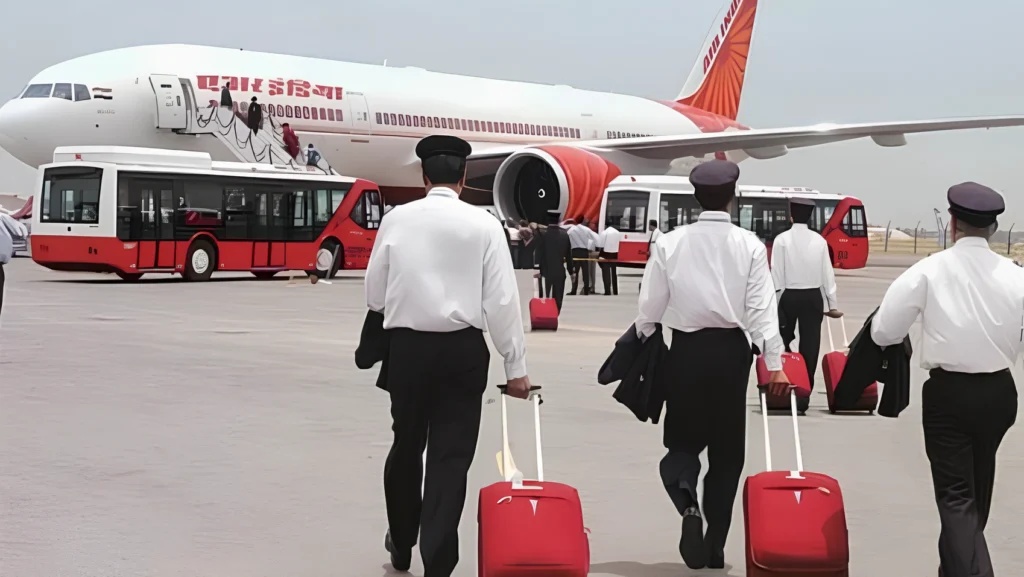
Understanding Air India’s Pilot Duty Exemption
The DGCA had provided a limited exemption in late April 2025 due to the closure of Pakistani airspace. This exemption permitted extended pilot duty for specific Westbound flights, capping it at 16 hours for journeys under 12 hours and 24 hours for longer flights, along with revised rest period requirements.
However, during a routine inspection, it was discovered that the two Bengaluru to London flights on May 16 and 17 (AI133) exceeded the standard 10-hour duty limit outlined in the Civil Aviation Requirements (CAR) Section 7, Series J, Part III.
Notably, these flights did not pass through Pakistani airspace and therefore were not entitled to the exemption. Despite this, Air India reduced its cockpit crew from three to two due to the relaxed guidelines.
The DGCA responded strongly, with a senior official criticizing this decision as “oversmartness.” On August 11, the regulator issued a formal warning to Air India’s CEO, Campbell Wilson, highlighting a lack of adequate corrective measures in response to a show-cause notice given on June 20.
Examining the Implications
Misapplying the exemption and reducing crew numbers puts Air India in violation of established flight duty time protocols and necessary crew-resourcing guidelines. This raises significant concerns regarding internal governance and the rigorous responsibility of the Accountable Manager to uphold safety rules.
The airspace restrictions have heavily impacted the airline’s finances, with estimated losses of around $600 million annually due to the need for diversions, increased fuel consumption, and scheduling pressures. The intention behind the exemption was to provide temporary relief, but exploiting its boundaries jeopardizes safety standards.
This isn’t the first incident; the DGCA has issued various notices to Air India for not adhering to pilot rest standards, falling short on cabin crew requirements for long flights, and noted training deficiencies. Such repeated violations indicate a troubling trend that necessitates immediate corrective measures.
Air India must enhance its regulatory oversight to prevent exemptions from being misused as a general workaround. Despite external pressures such as aircraft shortages or airspace limitations, strict adherence to Civil Aviation Requirements is imperative.
The recent warning issued to the CEO is not merely bureaucratic; it’s a clear reminder that safety must remain a top priority in all circumstances.
What are your thoughts on Air India’s handling of its pilot duty exemption?