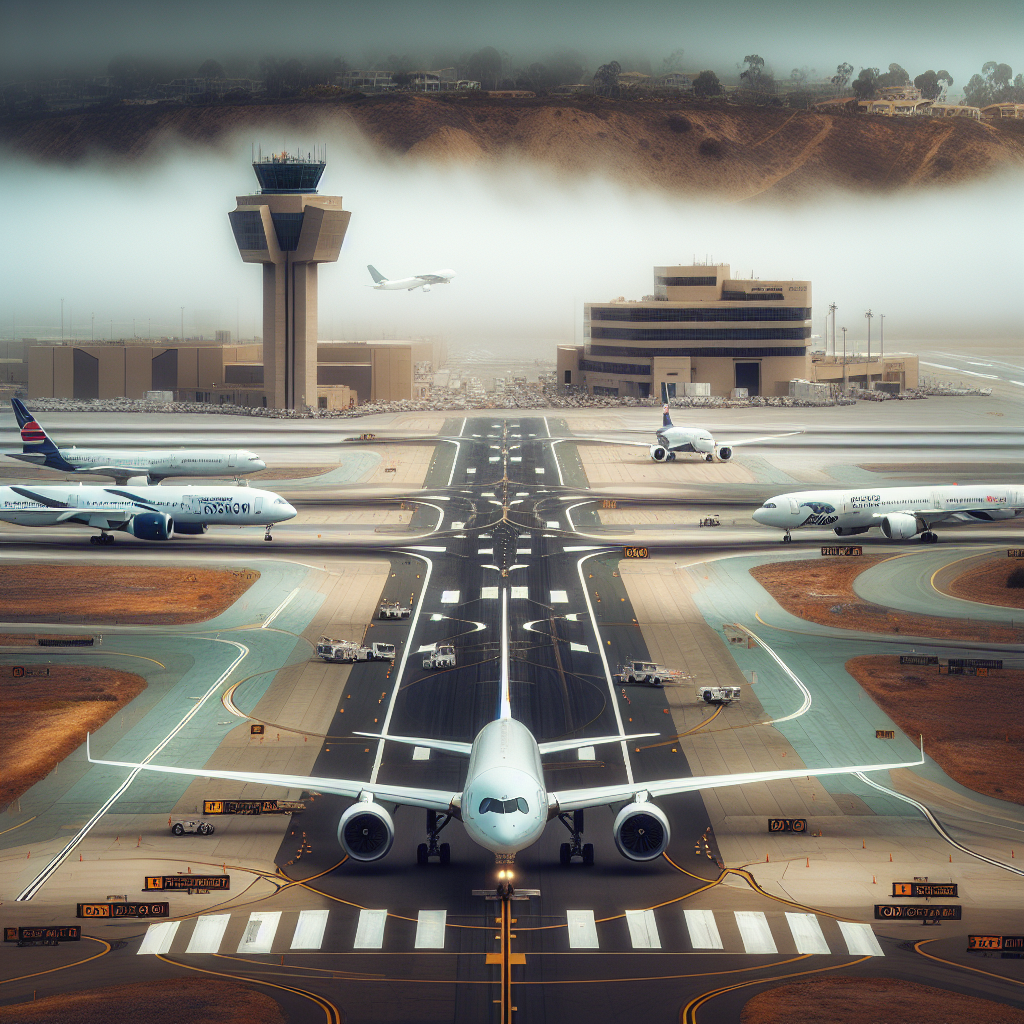
Lufthansa A350 and JetBlue A321 Collide at San Diego

Operational Challenges at San Diego Airport: A Look into the February 2025 Incident
San Diego International Airport (SAN) faced a significant operational challenge on February 7, 2025, shedding light on the limitations of its single-runway design. The airport’s unique configuration, with operational areas on both sides of the runway, often leads to complex traffic patterns that can complicate aircraft movements. This incident highlighted the need for improved infrastructure at SAN, especially during adverse weather conditions.
Severe Weather Compounds Airport Limitations
On that fateful day, dense fog and shifting wind patterns further complicated the airport’s logistical constraints. The single runway, designated as either Runway 9 or Runway 27, became the center of these challenges. Arriving flights used Runway 9 for eastbound landings, while departing aircraft faced restrictions due to unsafe wind conditions for departures on the same runway.
Initially, poor visibility prevented the use of Runway 27 for westbound departures, creating a bottleneck as aircraft were forced to wait for improved conditions. This led to a critical incident involving a Lufthansa Airbus A350 arriving from Munich and a JetBlue Airbus A321 preparing for departure to Boston, which ended up nose-to-nose on a taxiway.
Gridlock on the Taxiway: A Critical Incident
The gridlock situation escalated when the Lufthansa A350 landed on Runway 9, while the JetBlue A321 positioned itself for a departure from Runway 27. Unfortunately, spatial miscalculations prevented both aircraft from moving past each other on the taxiway, resulting in a standstill that lasted approximately one hour, as reported by OMAAT.
Modern commercial aircraft, including those involved in this incident, lack self-powered reverse capabilities, necessitating the use of a tug vehicle for repositioning. The air traffic control communications during this time revealed the tension in the air, as the controller maintained professionalism despite visible frustration.
Flight Delays and Operational Impact
The incident caused severe disruptions to flight schedules. The Lufthansa A350 faced significant delays in reaching its terminal, while the JetBlue A321, subjected to federal tarmac delay regulations, had to return to the gate. Consequently, the Boston-bound flight arrived nearly eight hours late, at 4:12 AM the following morning, instead of its scheduled 8:35 PM arrival.
Criticism was directed toward the air traffic controller’s decision-making during the incident. However, it’s essential to recognize the complex operational priorities at play, as the controller aimed to clear the active runway promptly, hoping that the taxiway could accommodate both aircraft. The wider fuselage of the A350 likely contributed to the miscalculation, as a narrower aircraft might have navigated the space successfully.
Conclusion: The Need for Infrastructure Improvement
This incident at San Diego International Airport underscores the critical need for infrastructure improvements to enhance operational efficiency and safety. As air traffic continues to grow, addressing the limitations of single-runway operations is essential to prevent similar occurrences in the future.
For more insights into aviation safety and airport operations, feel free to share your thoughts in the comments or explore our related articles on airport infrastructure and air traffic management.
References: