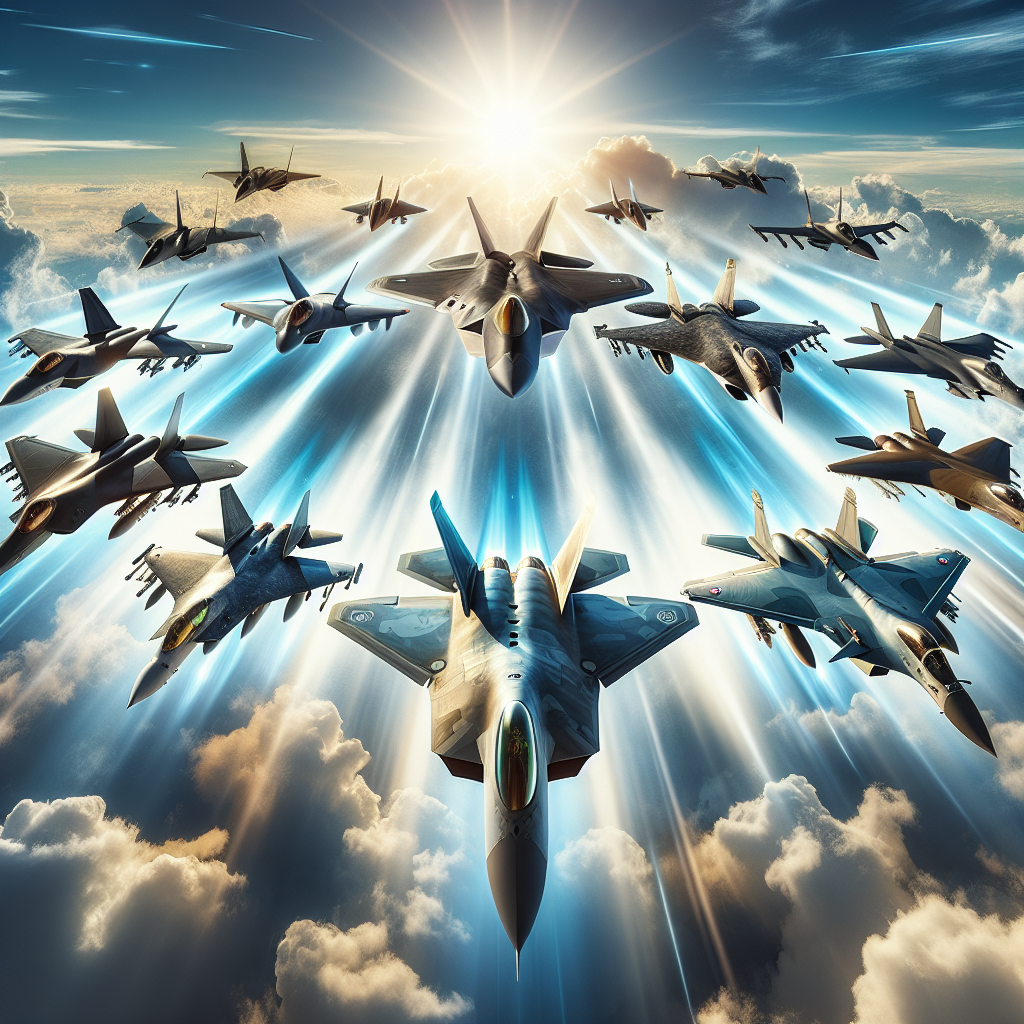
Top 7 Deadliest Fighter Jets of 2025

Title: The Top 7 Fighter Jets Dominating the Skies in 2023
In an era where many relationships struggle to stand the test of time, a select group of fighter jets has proven their resilience and adaptability. These magnificent machines continue to dominate the most challenging environment—the battlefield of the skies. Just like that ever-cool friend approaching middle age, these fighter jets have evolved and firmly held their spot at the pinnacle of military aviation. In this article, we explore the seven most formidable fighter jets of 2023 that remain unmatched in their aerial prowess.
1. F-22 Raptor: The Pinnacle of Air Superiority
The F-22 Raptor is widely regarded as one of the most advanced fighter jets ever built. Developed through a partnership between Boeing and Lockheed Martin, this aircraft entered service in 2007 with a primary mission of achieving air superiority.
Beyond its dogfighting capabilities, the F-22 excels in ground attacks, electronic warfare, and signal intelligence gathering. However, the steep price tag of approximately $150 million per unit makes it one of aviation’s most significant investments. Its low radar profile and advanced weapon systems are complemented by top-secret avionics. Despite its status, the F-22 is not invulnerable; NATO war games in 2009 revealed that the older Dassault Rafale could effectively challenge it.
2. F-15 Eagle: A Legacy of Success
The F-15 Eagle has solidified its place in history as one of the most capable jet fighters. Designed by McDonnell Douglas, the Eagle has an unmatched combat record, boasting over 100 aerial victories without a single defeat.
Its impressive performance has attracted international buyers, from Japan to Saudi Arabia. Recent upgrades, including the two-seat F-15E Strike Eagle variant, ensure that this veteran fighter remains relevant in modern combat scenarios.
3. Dassault Rafale: France’s Multirole Champion
The Dassault Rafale has carved out a reputation as one of the world’s leading multirole fighters. After a lengthy development period, the Rafale entered service in 2001, quickly proving its effectiveness in various combat scenarios, from Afghanistan to Syria.
With the capability to track 40 targets simultaneously and engage four, its advanced electronics set it apart. The Rafale’s prowess was notably demonstrated during exercises in 2009, where it successfully "shot down" an F-22, showcasing its competitive edge against U.S. technology.
4. Eurofighter Typhoon: A Collaborative Masterpiece
The Eurofighter Typhoon is a product of extensive international collaboration among the UK, Germany, Italy, and Spain. With exceptional agility and dogfighting skills, the Typhoon is often rated highly among its peers, including the F-15 and Rafale.
Plans indicate that the Typhoon will remain operational through the 2030s, continuing to adapt to new technological advancements in military aviation.
5. F-18 Hornet/Super Hornet: Versatile Naval Power
The F-18 Hornet, the U.S. Navy’s premier multirole fighter, has a long history of service since its introduction in the early 1980s. Its combat experience spans significant conflicts, including the Gulf Wars and operations in Libya.
The F-18 E/F Super Hornet variant has been modernized to incorporate advanced avionics, ensuring it remains competitive against contemporary threats.
6. Sukhoi Su-35: Russia’s Advanced Fighter
The Sukhoi Su-35 represents the apex of Russian fighter technology. Based on the Su-27 platform but extensively upgraded, the Su-35 has been operational since 2018 and is known for its remarkable speed and maneuverability.
Primarily designed for air superiority, the Su-35 also showcases strong ground attack capabilities, making it a versatile addition to Russia’s military arsenal.
7. F-16 Fighting Falcon: A Global Favorite
The F-16 Fighting Falcon has gained immense popularity worldwide, serving as the backbone of air forces from Turkey to Brazil. Originally designed as a dedicated air superiority fighter, the F-16 has evolved into a multirole platform, making it a preferred choice for many nations.
The latest F-16V variant incorporates cutting-edge technology, ensuring the aircraft remains a formidable contender even against newer fighters.
Bottom Line: The Future of Military Aviation
As these magnificent fighter jets continue their aerial ballet, they symbolize humanity’s remarkable ability to create both beauty and destruction. They represent extraordinary achievements in technology and engineering, designed to excel in the most demanding combat scenarios.
The geopolitical landscape and technological advancements will undoubtedly shape the future of military aviation. As new models emerge, these seven fighter jets will continue to be the monarchs of the skies, ready to respond to any challenge at a moment’s notice.
What are your thoughts on these incredible aircraft? Share your opinions in the comments or explore related articles for more insights into military aviation.