JetBlue Pioneers Free Amazon Kuiper Wi-Fi for Travelers Worldwide

NEW YORK- JetBlue Airways is set to transform its in-flight Wi-Fi experience by partnering with Amazon’s Project Kuiper. Starting in 2027, this collaboration will deliver faster and more dependable Fly-Fi service for passengers.
This partnership represents a key advancement for both JetBlue and Amazon’s satellite network, particularly at New York’s John F. Kennedy Airport (JFK).
As the inaugural airline to implement Project Kuiper’s low Earth orbit technology, JetBlue is committed to enhancing its free Wi-Fi service, ensuring that travelers enjoy uninterrupted connectivity from gate to gate.
JetBlue Fly-Fi Free Wi-Fi
Since the launch of Fly-Fi in 2013, JetBlue Airways has led the charge in providing in-flight Wi-Fi, being the first major U.S. airline to offer free, high-speed internet across its fleet.
Now, with the collaboration with Project Kuiper, a low Earth orbit (LEO) satellite broadband network, JetBlue aims to enhance this service by providing improved speeds and reduced latency.
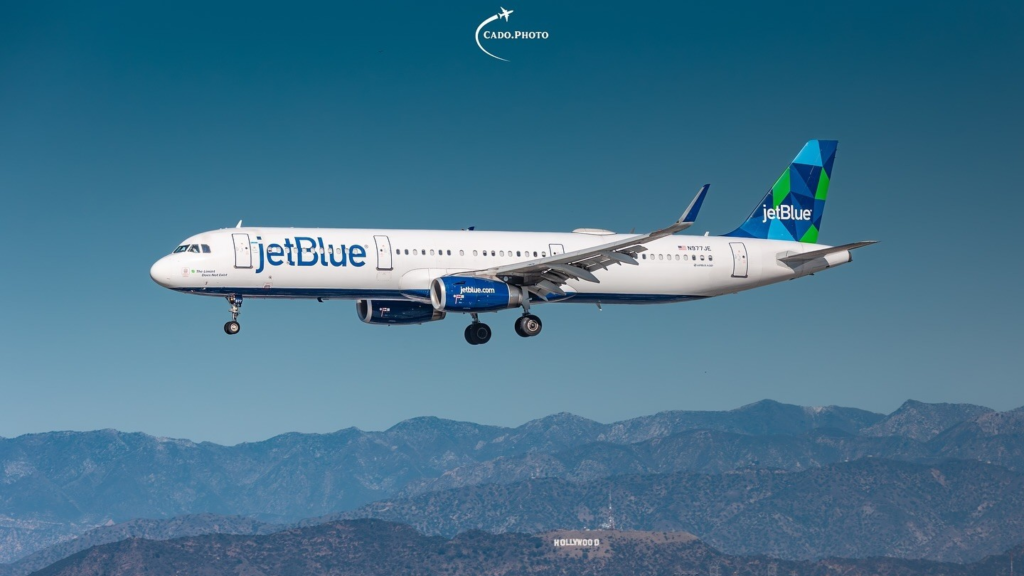
The rollout will kick off in 2027 for selected aircraft, focusing initially on older Airbus A321 models flying out of airports like JFK and Boston (BOS). By 2028, around 25% of JetBlue’s fleet is expected to feature the Kuiper technology, ensuring complimentary Wi-Fi for all passengers.
Project Kuiper utilizes a network of over 3,200 satellites positioned 367 to 391 miles above the Earth. This structure, connected by high-speed optical links, forms a global mesh network.
This innovative system promises high-speed, low-latency internet, capable of supporting streaming, browsing, and work tasks at 35,000 feet.
In contrast to traditional geostationary Earth orbit (GEO) satellites, which orbit at 22,369 miles and can have higher latency, Kuiper’s network could deliver download speeds reaching up to 1 Gbps. This significantly outperforms competitors like SpaceX’s Starlink, which offers speeds up to 250 Mbps.
Strategic Vision and Passenger Benefits
JetBlue’s partnership with Project Kuiper aligns seamlessly with its JetForward strategy, which prioritizes speed, simplicity, and an enriched passenger experience. “This agreement marks a leap forward in onboard connectivity,” stated JetBlue President Marty St. George.
“It guarantees customers can enjoy streaming, stay connected, or complete work seamlessly.”
The airline will continue its relationship with Viasat, which currently provides its GEO-based Fly-Fi, while exploring a combination of both LEO and GEO networks for increased reliability.
Project Kuiper aims to bridge the digital divide by delivering broadband to underserved communities, with JetBlue as its premier airline partner. “Connectivity is essential, whether at home or in the air,” remarked Panos Panay, Senior Vice President of Amazon Devices & Services.
This initiative, supported by Amazon’s $10 billion investment, has seen over 100 satellites deployed since April 2025 and plans to launch an additional 27 to meet federal requirements by July 2026.
Future Outlook
The installation of Kuiper technology will commence in 2027, aiming for full deployment by 2028. The initial focus will be on older aircraft equipped with Fly-Fi, facilitating a smooth transition for passengers.
Details regarding specific routes, aircraft types, and timelines will be shared as the launch date approaches. JetBlue’s commitment to free Wi-Fi distinguishes it from competitors, like United Airlines and Hawaiian Airlines, which are teaming up with Starlink.
This partnership also solidifies Amazon’s Project Kuiper as a formidable rival to Starlink’s extensive satellite network. With Airbus integrating Kuiper’s technology into its aircraft offerings, the reach of this system could broaden significantly.
JetBlue’s exploration of multi-orbit solutions may improve connectivity during challenging weather conditions, ensuring consistent performance across its vast network of over 100 destinations, including Fort Lauderdale (FLL) and Orlando (MCO).
What do you think about the future of in-flight connectivity with JetBlue’s new initiatives?