United Airlines Under Fire for Denying Wheelchair Storage to Disabled Flyer

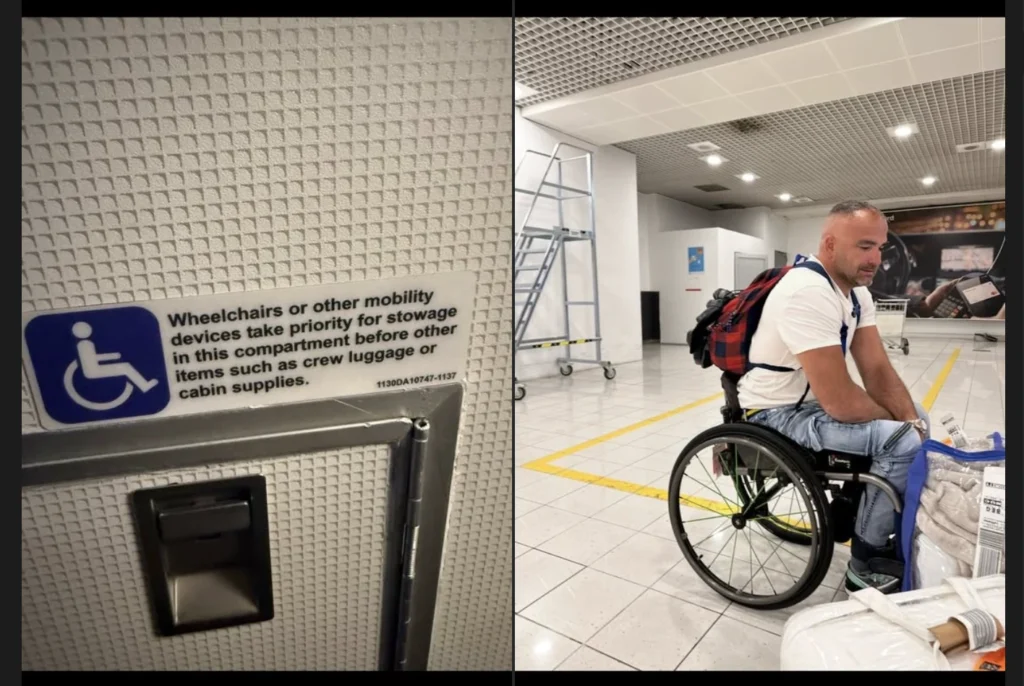
CHICAGO– An incident involving a United Airlines (UA) flight attendant has sparked outrage after a disabled passenger was denied storage for their manual wheelchair in the designated area. The crew cited the need for space already occupied by their own luggage, leading to frustration for the passenger’s spouse.
This episode unfolded during a long-haul flight originating from a United Airlines hub. Despite the federal regulations that mandate priority storage for wheelchairs, the crew’s refusal to move their bags left the family exasperated.
United Airlines Faces Backlash
Sarah Bambur highlighted the ordeal on a United Airlines passenger Facebook group, recounting her husband’s experience when their custom wheelchair was not allowed in the designated stowage closet. This closet even had a sign that stated “Wheelchair Storage First,” yet the attendants insisted that their bags took precedence.
Bambur pointed out that she had previously stored the same wheelchair in similar compartments on international flights without any trouble. The wheelchair’s removable wheels and compact design enable it to fit perfectly, allowing her husband access to the accessible restroom facilities. Additionally, the specialized cushion is critical for preventing pressure sores, which traditional aisle chairs cannot offer.
The crew’s response was described as unhelpful and curt, with the flight attendant speaking firmly and declining to move their bags. The post soon gathered attention from fellow travelers and advocates for disability rights.
Federal Law Mandates Priority Storage for Wheelchairs
According to U.S. regulations, airlines must provide a dedicated onboard area for at least one manual wheelchair on aircraft with more than 100 passenger seats, outlined under 14 CFR § 382.67 of the Air Carrier Access Act amendments from 2008.
This regulation applies to both U.S. and foreign airlines operating flights to or from the U.S. Specifically, if a passenger requests the wheelchair space, crew baggage should be moved unless the chair is too large or multiple requests are made—handled on a first-come, first-served basis.
However, despite these clear guidelines, reports from passengers suggest that crew members often overlook or ignore these requirements. The Department of Transportation (DOT) continues to receive complaints about accessibility violations and wheelchair mishandling.
United’s Track Record and Previous Controversies
According to DOT data from July 2025, United Airlines (UA) mishandled 151 wheelchairs, which results in 1.35 incidents per 100 enplaned wheelchairs. Other airlines, including Frontier, Spirit, American, and Hawaiian Airlines, reported higher rates, while Delta Air Lines ranked best among major carriers.
This is not the first time United has faced backlash regarding accessibility. In 2023, they undertook efforts to improve service for wheelchair users after a DOT investigation into the tragic death of Engracia Figueroa, whose custom wheelchair was damaged by the airline. Subsequent complications led to her death.
Previously, United settled for $30 million with the family of Nathaniel Foster Jr., a quadriplegic passenger who suffered fatal injuries from a deplaning incident in 2019 at Monroe Regional Airport (MLU).
Broader Implications for Accessibility in Air Travel
This incident emphasizes a significant gap between the policies that airlines promote and the actual experiences faced by passengers with disabilities.
The laws are clear: manual wheelchairs deserve priority in designated storage areas. However, the effectiveness of these regulations largely depends on the awareness and responsibility of airline crews.
For many disabled travelers, having their wheelchairs onboard is essential not only for comfort but also for dignity and safety. Every mishandled or damaged wheelchair represents more than just an inconvenience; it affects the passenger’s health, mobility, and overall independence.