Japan Airlines Sells Discarded Parts from Boeing 777 Aircraft

TOKYO- Japan Airlines (JL) is offering unique items made from retired Boeing 777 (JA772J) aircraft parts at Yokohama Takashimaya (YOK) from July 30 to August 12, 2025. Shoppers can find exclusive pieces such as fuselage skin tags, life vest keychains, and upcycled seat cover furniture.
In addition to these sales, JAL and other prominent companies have launched the first phase of a new Scope 3 environmental value trading initiative aimed at supporting sustainable aviation fuel (SAF) and carbon reduction efforts within Japan’s aviation sector.

Japan Airlines Launches Collection from 777 Parts
JAL Engineering, a branch of Japan Airlines (JL), is furthering its commitment to sustainability through its fourth annual upcycling event in Yokohama.
This year, various components from the retired Boeing 777-200 (JA772J) will be repurposed into consumer products at Takashimaya’s 6th-floor men’s accessories section. The sale will continue until August 12 or until stock is depleted.
Featured products include:
- Fuselage Skin Tag: Crafted from the plane’s outer shell.
- Miniature Life Vest: Made from leftover safety equipment.
- Body Bags: Assembled from economy class seat covers.
- Stools: Constructed using materials from Boeing 777 seats.
This project exemplifies Japan Airlines’ overarching sustainable goals, repurposing materials that might otherwise go to waste while actively involving consumers in the story of aviation heritage and environmental responsibility.
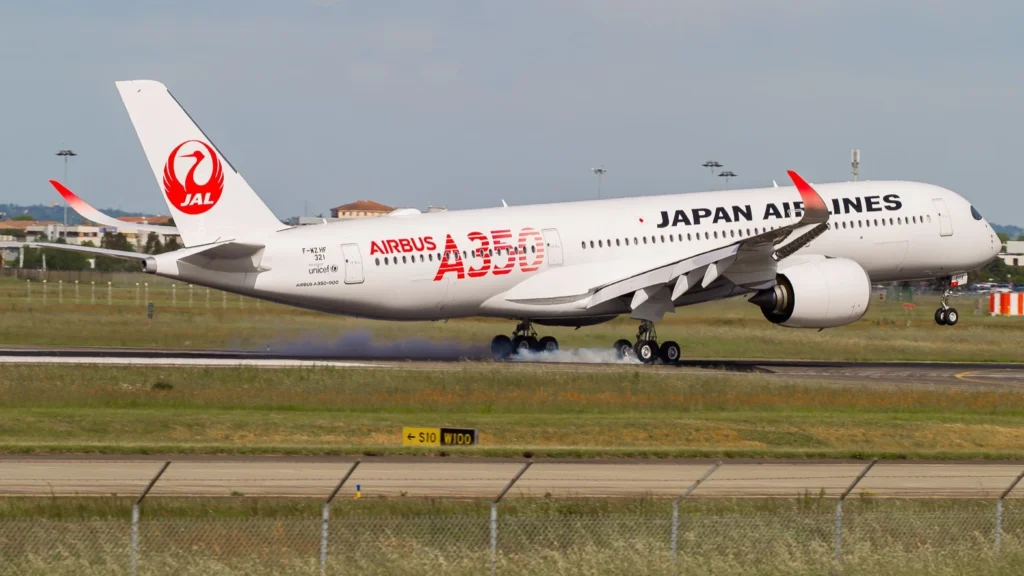
Separately, Japan Airlines (JL) has recently received its first Airbus A350 following heavy maintenance at ST Engineering’s Singapore facility, signaling new developments in its collaboration with its maintenance provider.
This partnership encompasses various phases throughout the aircraft’s lifecycle, with an emphasis on reliability, safety, and operational efficiency, allowing JAL to maintain its fleet while facilitating expansion and network growth.

Transition to Phase Two of Scope 3 Environmental Value Trading
A collaborative project was initiated in August 2024 involving seven leading Japanese businesses alongside Japan Airlines (JL) to establish a Scope 3 environmental value trading system.
The main objective is to expedite the integration of sustainable aviation fuel (SAF) by facilitating the assignment and exchange of environmental value among participating entities.
Key Details from Phase One:
- Participants: ITOCHU, ENEOS, NIPPON EXPRESS, Mizuho Bank, Mizuho Research & Technologies, Narita International Airport (NRT), and Japan Airlines (JL).
- Duration: August 2024 – March 2025.
- Outcomes:
- Successful registration and trading of environmental value data on a digital platform.
- Bilateral contracts were matched and formalized.
- The entire procedure was audited for transparency by ClassNK.
Phase one demonstrated the feasibility of this model. With solid results, phase two will welcome more participants and further challenge the trading process as it gears up for broader implementation.
Roles within the SAF Ecosystem
Each collaborator has a distinct role in the emerging SAF and Scope 3 trading landscape:
- ITOCHU: Leading the commercial adoption of SAF and trading methodologies.
- ENEOS: Developing a complete SAF supply chain from feedstock to distribution.
- NIPPON EXPRESS: Assessing logistics framework suitability.
- Mizuho Group: Providing financial backing and operational support.
- Narita International Airport (NRT): Aiming to green airport functions.
- ClassNK: Validating environmental value exchanges through third-party oversight.
The collective aim is to establish a sustainable infrastructure for Scope 3 value exchange, offering airlines and airports effective pathways to achieve their decarbonization targets.
Japan Airlines is weaving genuine sustainability efforts into both public initiatives and industry-level structures. The sale of collectible aircraft parts serves as a consumer-friendly approach to circular design, while JAL actively collaborates across various sectors to implement environmental trading systems conducive to large-scale SAF adoption.
Are you excited about the innovative sustainability efforts in aviation?