Investigation Launched into China Eastern 777 Pilots’ Missed Go-Around in Singapore

SINGAPORE— A recent incident involving a Boeing 777-300ER operated by China Eastern Airlines has raised safety concerns at Singapore Changi Airport (SIN). The crew did not respond to a go-around call, which led to a potential runway incursion with another aircraft.
On August 28, 2024, both aircraft from China Eastern — a Boeing 777-300ER arriving from Shanghai Pudong (PVG) and an Airbus A320neo, also inbound from Shanghai — were involved in this event. This information has been detailed in the final report from the Transport Safety Investigation Bureau (TSIB).
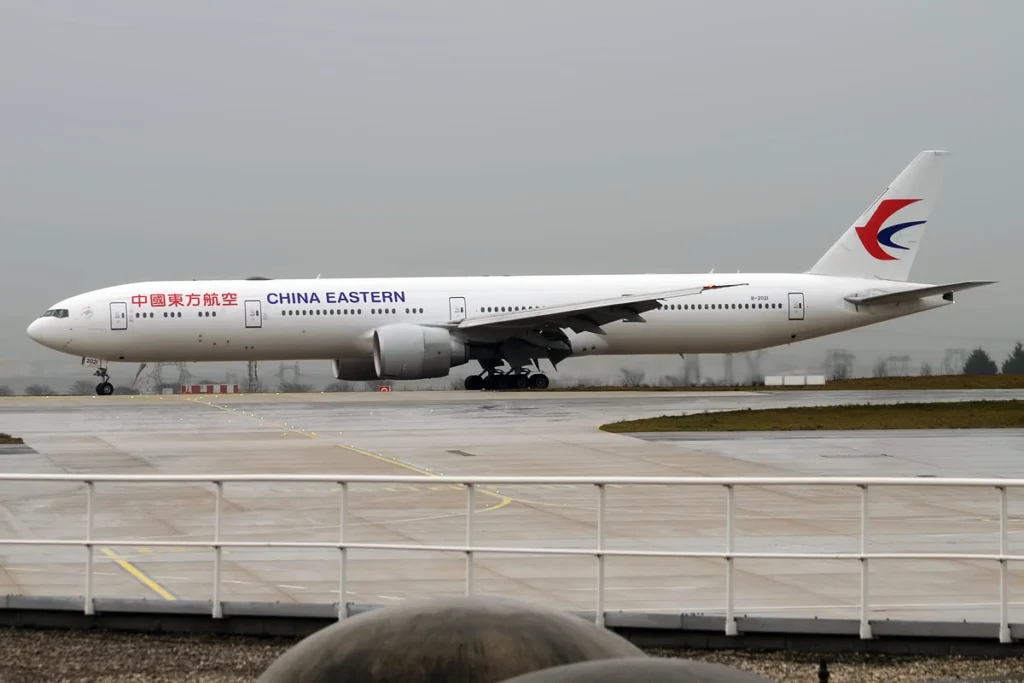
China Eastern 777 Missed Go-Around
The incident unfolded as the Airbus A320neo (registration B-30AV) landed on Runway 20R. The crew received instructions to vacate the runway via exit 7; however, their speed was too high to use exit 6, requiring them to brake before navigating to exit 7.
Simultaneously, the Boeing 777-300ER (registration B-2021) was cleared to land on the same runway. With separation becoming critical, air traffic control urged the A320neo crew to exit more rapidly.
Despite reducing their speed into exit 7, the A320neo pilots hesitated to proceed onto taxiway W until further clearance was provided.
At that point, air traffic control instructed the A320neo to immediately turn onto taxiway W and ordered the Boeing 777, which was just 76 feet above ground and 296 meters from the runway threshold, to execute a go-around.
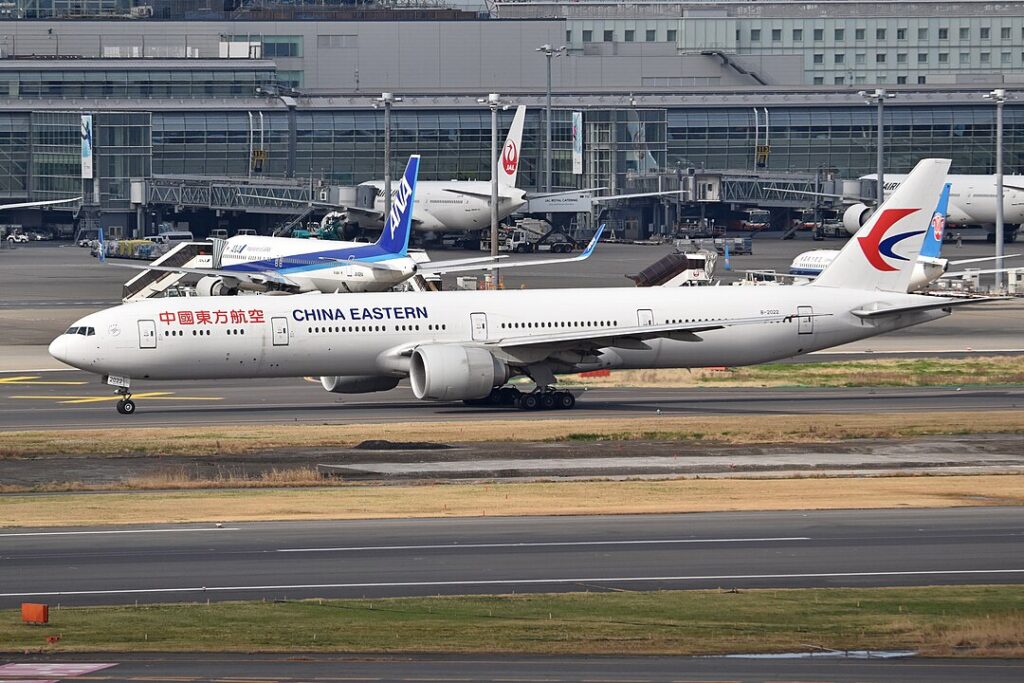
Missed Go-Around Call
The TSIB report revealed that the crew of the Boeing 777 did not recognize the go-around instruction and continued to land. Consequently, warnings triggered on the controller’s screens.
Since the A320neo’s tail had cleared the runway edge, the controller decided a go-around was unnecessary. Both aircraft continued to taxi and safely reached their terminals.
The Boeing 777’s crew later indicated they did not hear the go-around call. Investigators suggested that the Enhanced Ground Proximity Warning System (EGPWS) was likely emitting altitude call-outs that obscured the controller’s command.
Additionally, the go-around command was issued right after a radio transmission to the A320neo, possibly adding to the communication confusion.
In response to this incident, the Civil Aviation Authority of Singapore (CAAS) has encouraged controllers to promptly issue go-around commands when separation issues arise.
This situation will serve as a case study in operational training. China Eastern has also reminded its pilots to be attentive to go-around instructions at low altitudes.
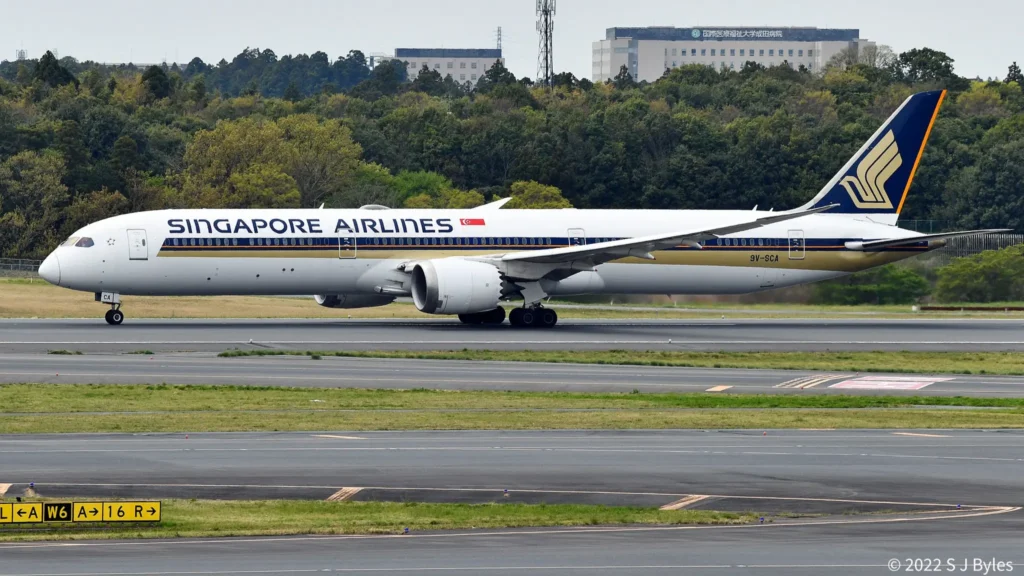
Similar Incident
In a separate event, a Boeing 787-10 Dreamliner from Singapore Airlines overran the runway at Tokyo Narita Airport (NRT) on July 20, 2025. This incident occurred while operating flight SQ638 from Singapore Changi Airport (SIN) with no injuries reported.
The incident occurred while landing on Runway 16L at approximately 07:59 local time. The aircraft stopped with its nose gear in the runway end safety area (RESA) and required towing assistance for clearance.
Details of the Incident
The involved aircraft, registered 9V-SCJ, is a 6.3-year-old Boeing 787-10 Dreamliner. It took off from Singapore Changi (SIN) on July 19 and landed at Tokyo Narita (NRT) on July 20 at 07:59 local time (22:59Z).
While landing on Runway 16L, measuring 2,500 meters (8,200 feet), the jet reportedly overshot the runway threshold at a ground speed of around 15 knots. It came to a complete stop in the paved RESA, developed to enhance safety during such overruns.
Emergency and ground services responded swiftly, and approximately 40 minutes later, the aircraft was towed to a safe location for inspection.
Aircraft and Technical Assessment
Following the event, thorough checks were conducted on the Boeing 787-10, revealing no immediate damage or technical issues. The aircraft was eventually cleared for operations.
However, the return flight to Singapore faced a delay of about 3.5 hours due to the time needed for towing, safety inspections, and necessary procedures before resuming service.
Runway 16L at Narita, being 2,500 meters long, is shorter compared to other primary runways, which could present challenges for wide-body aircraft like the Boeing 787-10 under specific operational conditions.
While the investigations continue, this incident emphasizes the significance of runway length, braking capabilities, and environmental factors during landing operations.